I walk through the centre of Katerini and count closed shopfronts. Not only retail — cafés too. That surprised me, because the usual story is that shops close and cafés open in their place. Here both are leaving.
I went looking at the numbers expecting to find a shrinking town. I found the opposite.
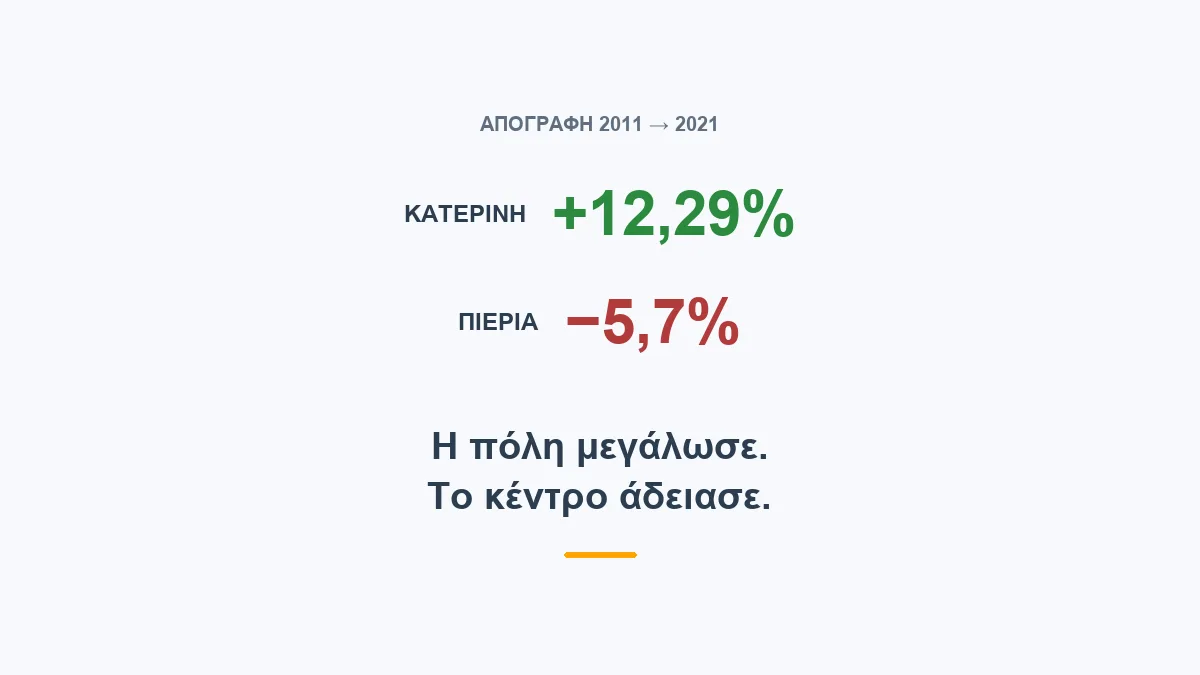
The city grew. The centre emptied.
From the 2021 census:
- Pieria lost 5.7% of its population in a decade — 7,212 fewer residents than in 2011.
- Katerini itself grew by 12.29%, from 52,709 to 59,189 residents. It is the only city in Central Macedonia whose population increased.
So: 6,480 more people inside the city, and the centre is emptying.
That kills the easy explanation. It is not that people left. People arrived. They just do not go where they used to go.
First cause: the city grew outwards
The 7,212 Pieria lost did not vanish — most of them moved. The villages emptied into Katerini.
The question is where inside Katerini. Someone arriving from a village is not looking for a flat in an old block with no parking. They are looking for a house on the edge of town, with a driveway and a yard. And the moment you have a car and a parking space, the centre stops being the natural destination — it becomes a decision you have to justify.
Second cause: the shelf moved into the phone
In 2025, 77.6% of Greek consumers shop online often or very often. Only 0.5% say they never do.
And the number that matters here: 75.7% buy clothing and footwear online.
Think about what the centre of a Greek provincial town was. Clothes and shoes. That was the shop window. That entire category got up and moved into the phone — and it did not leave gradually, it left en masse.
A clothing shop in the centre no longer competes with the one next door. It competes with an app that has infinite stock, returns with no questions, and does not ask you to find somewhere to park.
Third cause: coffee became a decision
I got this wrong at first. I assumed cafés were closing because they lost the footfall the shops next door used to create. Reasonable, but the numbers say something simpler: people avoid them because the bill does not work.
A take-away coffee used to cost €1.90 to €2.70. Today it costs €2.20 to €4.20 — an increase of 55.5%. Instant coffee is up over 40%, Greek coffee over 20%. The freddo, which is what half of Greece drinks, remains reliably the most expensive thing on the menu.
Now put income next to it. According to Eurostat (Key figures on European living conditions, 2026 edition):
- 87.1% of Greeks report major or very major difficulty meeting daily needs. The EU average is 42.5%.
- 27.3% say they cannot regularly take part in leisure activities for financial reasons — the worst rate in the European Union.
One in four does not go out because they cannot afford to. That is not a footfall problem.
And it shows in the tills: food service closed 2025 with turnover down 1.9%, which in deflated terms means real consumption fell close to 5% — and that during a "golden" tourist summer. In the consumer basket, the weighting for restaurants and accommodation dropped from 20.1% in 2025 to 17.7% in 2026. People are not paying more for the same; they are cutting.
The common thread
The two causes look unrelated — one is technology, the other is prices. In practice they do the same thing.
The centre used to be a cheap place to be. You went for a walk, looked at windows, maybe bought something, maybe had a coffee. The walk was free and the rest was optional.
Today the window shopping happens on your phone, and the coffee costs four euros. What is left of the centre has a price tag on it. And when 87.1% of people struggle with daily expenses, a walk that costs ten euros for two becomes a decision — and decisions get postponed.
The sign that they know it too
The Katerini Commercial Association asked for, and the Pieria Chamber approved, an optional extension of trading hours until 31 August 2026 — Tuesday, Thursday and Friday, 18:30 to 21:30 — with the stated aim of "stimulating shopping activity".
Nobody asks for longer opening hours when they have queues. It is an admission, and an official one.
Will it help? Partly. If the problem is that you work until five and the shops shut at five, those extra hours count. If the problem is that you already ordered the shoes from your bed, they count for nothing.
What I cannot prove
Let me be honest about the limits of what I have written.
There is no published figure for how many shops closed in Katerini's centre, or how many cafés. INEMY-ESEE runs semi-annual "closed shops" surveys, but for large cities. For Katerini, all I have is what I see when I walk. I write it as an observation, not a measurement.
I also do not know the weight of rents with any certainty. It is reasonable that rents did not adjust as fast as turnover fell — that is almost always what happens, because a landlord prefers an empty shop to a permanently lower price. But I have no figures for Katerini, so I leave it as a hypothesis.
The uncomfortable conclusion
The centre is not emptying because the town is dying. It is emptying while the town grows. That is worse, because it means no recovery is coming to fix it. The 6,480 new residents are already here — and they have found a way to live without the centre.
And they did not find it because the centre got worse. They found it because the centre became expensive to visit, at the same moment everything it sold became cheaper from the sofa.
A town centre survives when it offers something a phone and a supermarket car park cannot — and when that something does not cost ten euros to look at. Extended trading hours give more time to people who are not missing because they are busy. They are missing because they are counting.