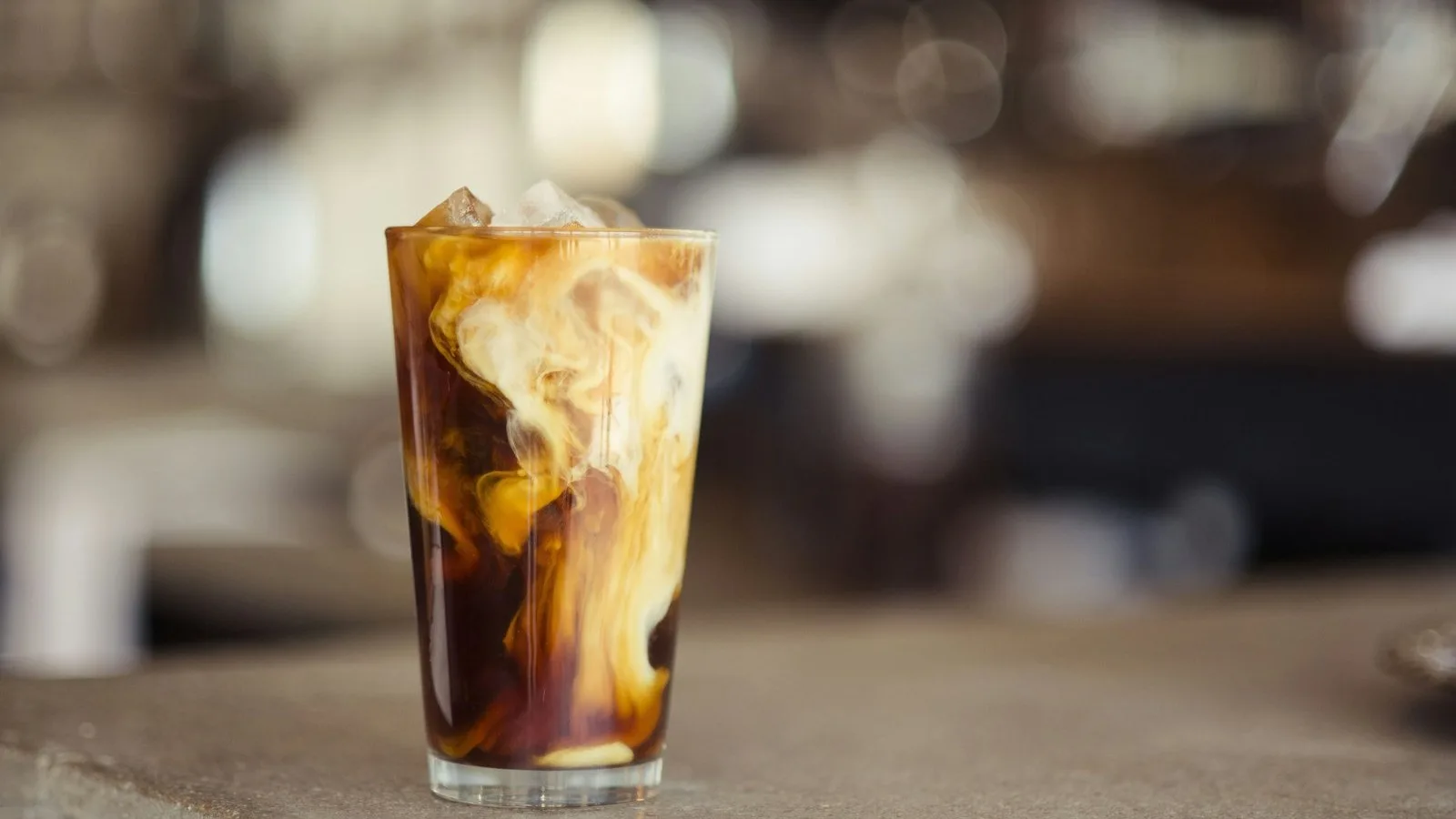
I like coffee. Not in the "I drink three a day" sense — in the sense that I care how it is made: where the bean comes from, what roasting does to it, why two espressos from the same machine come out different.
So when I recently paid €4 for a freddo espresso, I did not get angry. I asked a more boring question:
How much coffee is there inside those €4?
I sat down and worked it out. The answer surprised me enough to write about it.
The calculation
Step by step, with the cards face up.
Arabica — the bean in your espresso — is an exchange-traded commodity. On 30 September 2026 it closed at 294.85 US cents per pound on ICE.
- 294.85 cents/lb = $6.50 per kilo of green coffee
- At 1.1380 (the September 2026 average rate) = €5.71 per kilo
- Roasting loses roughly 18% of the weight, so one kilo roasted needs ~1.22 kg green = €6.97
- A freddo espresso is a double: 18 grams of roasted coffee
18 g × €6.97/kg = 12.5 cents
Twelve and a half cents. In a four-euro coffee, the bean is 3.1%.
And now the part I did not expect
In Greece coffee carries an excise duty, in force since 1 January 2017 (law 4389/2016). Few people know, because it appears nowhere on the bill:
- Non-roasted (green): €2/kg
- Roasted: €3/kg
- Instant: €4/kg
On your 18 grams, that is 5.4 cents.
And on top comes 24% VAT, because you are sitting in the shop. On a €4.00 menu price, the VAT inside that price is 77.4 cents.
Bean: 12.5 cents.
State (VAT + excise): 82.8 cents.
The state takes 6.6 times more than the coffee.
And one detail that shows how arbitrary the system is: the exact same coffee carries 24% VAT if you sit down and 13% if you take it away or have it delivered. Same bean, same machine, same barista. Two prices.
What the world price did this year
This is where it gets interesting, because 2026 was a wild year on the coffee exchange:
- June: arabica collapsed 37.8% to the year's low, $2.3885 per pound.
- Early July: it shot back up around 49.5%, to $3.57.
- Late August: another peak, around $3.42.
- Mid-September: back down to $2.87 — a 14.3% fall inside 30 days.
Now ask the obvious question: what was all that madness worth in your cup?
At $2.3885/lb your bean costs 10.2 cents.
At $3.57/lb it costs 15.2 cents.
The entire annual swing: 5 cents.
Five cents. In a four-hundred-cent coffee.
So who is telling the truth?
Here the argument cuts both ways, and I think that is the most useful part.
First, against "world prices went up". If the bean is 3% of the cup, then no world price justifies a 50-cent increase on the menu. The argument does not survive the arithmetic.
Second, in defence of the cafés. By the same logic, when the world price falls, there is not much to pass on. You cannot demand the freddo drop 50 cents because arabica fell, when the whole fall is worth five.
The conclusion is the same in both directions: the bean is not the story. It is the alibi.
Then what are you paying for?
You are paying rent, wages, electricity and tax. The coffee is the pretext; what you are buying is a seat in a shop for forty minutes.
That is why the freddo never gets cheaper. It is not a conspiracy — it is that 97% of its cost has nothing to do with coffee, and that 97% never goes down. Rents do not fall. Wages do not fall. VAT does not fall.
There is also the effect economists call "rockets and feathers": cost increases reach the shelf like a rocket, decreases drift down like a feather. It is real, and you see it everywhere. In coffee it is simply secondary to the main point: there is not enough coffee inside the coffee for it to matter.
The picture in Greece
For scale: according to ELSTAT data, coffee prices rose 18.5% between August 2024 and August 2025, reaching levels not seen for roughly 45 years.
At the other end, production: the USDA forecasts a record 189.7 million bags globally for the 2026-27 season, up 6%, with arabica up 12%. Yet ICE certified arabica stocks fell to a 2.5-year low — 266,204 bags. A record crop and empty warehouses at the same time, which is why the price did not collapse despite the harvest.
What I cannot prove
My calculation is transparent but it rests on assumptions, and you should see them:
- 18 grams per freddo. Some use 16, some 20.
- 18% roast loss. The range is 15-20%.
- I use the exchange price of green coffee, not what a café actually pays. A café buys it roasted, packed and delivered — far more expensive. The 12.5-cent figure shows how much of your price is linked to the world market, not the business's raw-material cost.
- The price and the exchange rate are from one day. Tomorrow they differ.
Move the assumptions within sensible limits and the bean lands between 10 and 18 cents. It never lands at €2. The conclusion does not move.
And something personal
I am not writing this to talk you out of buying coffee out. I buy it too.
I am writing it because I like knowing what I am paying for. And because once I understood the bean is 3%, it changed how I choose: if 97% is the space, the person and the time, then it is worth choosing a good space and a good person. You are spending the four euros anyway.
At home, where you pay only for the bean, the arithmetic inverts completely — and there it really is worth researching what you buy.
If you run a café and your own numbers say something different, write to me. I would genuinely like to see a real costing.
Sources: arabica prices and ICE stocks via Barchart; USDA production forecasts; excise duty rates from the AADE guide to coffee products (law 4389/2016); EUR/USD September 2026 average; ELSTAT data on coffee inflation. The calculations are my own, under the assumptions stated above. Photo: Demi DeHerrera / Unsplash.