I grew up in Paralia Katerinis. I know exactly the difference between December, when you walk the promenade and hear your own footsteps, and August, when you cannot find anywhere to park.
This year, in late September, the beach was still full. And the question I asked myself was simple: was it a good season or not?
I went looking for numbers instead of impressions. The answer turned out to be more interesting than I expected.
The short answer
Neither down nor up. The people came — the money thinned out.
That is not a neutral outcome. It is the most expensive scenario for a business: you do the work, you carry the cost, and you watch the margin shrink.
What the national numbers say
Start from the top, because that is where clean data exists. For the first half of 2026:
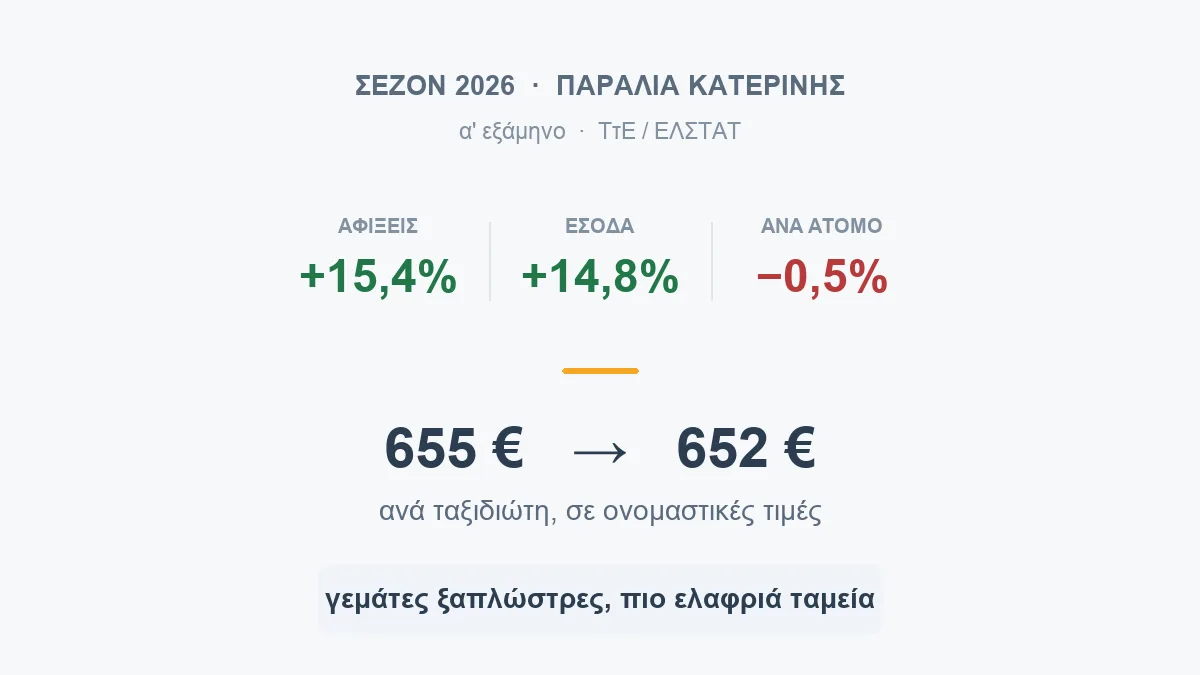
- Bank of Greece — travel receipts of €8.796 billion, up from €7.664 billion in H1 2025. A rise of 14.8%.
- ELSTAT — inbound travel of 13.491 million travellers, up from 11.692 million. A rise of 15.4%.
At first glance, an excellent year. Now do the division:
€8.796bn ÷ 13.491m = €652 per traveller
€7.664bn ÷ 11.692m = €655 per traveller
Arrivals rose faster than receipts. So spend per traveller fell by half a point — in nominal terms. Add inflation on top and real spend per visitor is clearly below last year.
Put plainly: more of them came, each one spent less.
Now Pieria, month by month
Pieria has roughly 21,000 hotel beds, and 90% of them sit in the municipalities of Katerini and Dion-Olympos. When we say "Pieria", we are essentially talking about Paralia and the coastline around it.
The year was not uniform:
- April: moved along satisfactorily.
- May: the worst in recent years. In early May the average booking rate was just 45%, down 15-20% against May 2025.
- July: reasonable for the region.
- August: occupancy around 80%.
- September: quite satisfactory arrivals and occupancy — and anyone who passed through Paralia mid-month saw it with their own eyes.
The season closed, according to the Pieria Hotels Union, with arrivals and overnight stays at the same level as last year, and a positive sign on revenue.
That sounds good. Until you read the next sentence.
The finding that matters
Iraklis Tsitlakidis, president of the Pieria Hotels Union and vice-president of the Greek Hotels Federation, says it plainly: average per-capita spending and spending per traveller were restrained, and certainly lower than last year. Visitors kept their wallets shut mostly on food, shopping and entertainment.
Those are exactly the three things that keep the Paralia promenade alive. The hotel gets paid either way — the taverna, the clothes shop and the bar get paid out of whatever is left over.
And the same pattern shows up across Northern Greece:
- Halkidiki: average July occupancy 80%, down from 85-90% in July 2025. Bookings down 5-10%.
- Kavala: around 85% occupancy in August, but with noticeably reduced purchasing power.
- Thasos: revenues below 2025.
For Pieria, the best case described back in August was "revenues at last year's level, but with lower profitability".
Why it happened — three concrete reasons
Paralia Katerinis is particularly exposed here, for one reason: 70% of Pieria's bookings are road tourism. This is not a destination that lives off charter flights. It lives off cars driving down from the Balkans.
The six largest source markets are Romania, Bulgaria, Greece, Germany, Serbia and North Macedonia.
1. Bulgaria joined the euro
From 1 January 2026, at a rate of 1.95583 lev to the euro. A miniature version of what happened in Greece in 2002: domestic costs rise and purchasing power comes under pressure. Bulgaria remains last in the EU for GDP per capita in purchasing power terms. The effect showed: fewer Bulgarian visitors.
2. EES at the land borders
The new European Entry/Exit System takes a photograph and biometric data from every third-country national. That means Serbians and North Macedonians — precisely the crowd that drives through Evzoni to reach Paralia.
The result was queues kilometres long at Evzoni and Doirani. In June, Athanasios Malliaris, president of the Regional Chambers Council of Central Macedonia, wrote to the ministries asking for adequate equipment and more staff at the control points.
Think about it practically: a family from Belgrade planning a four-day trip starts reconsidering when they know three hours at the border are waiting for them — in each direction.
3. General European cost-of-living pressure
The third piece is the same one I wrote about for the centre of Katerini: when people are squeezed, they do not cancel the holiday. They cut the second drink, the souvenir and dinner out.
That is why this year's bookings were not merely last-minute. Tsitlakidis described them as last-second bookings — with the exception of the mid-August long weekend. When you do not know what you will have spare in two months, you do not prepay in May.
The comparison that gives perspective
To be fair to 2026, it is worth remembering what 2025 looked like.
In August 2025, Dimitris Karavides, president of the Katerini catering association, said: "This is the worst summer for occupancy, the drop is at least 30 to 40%." June non-existent, July very weak, and August salvaging what it could with help from the diaspora.
So this year's "same level" is not being compared against a good year. It is being compared against an already difficult one. That changes quite a lot about how you read the word "stability".
What it means for Paralia in practice
Three things, as I see them:
September works. This year the sea was swimmable and people were there in the middle of the month. Extending the season is no longer theory — it is the most realistic growth margin the place has.
Volume is not enough. If the strategy is "get more people here", 2026 showed that more people can bring less money. The question is not how many come, but what reason you give them to spend.
Borders are infrastructure. For a destination that is 70% road tourism, queues at Evzoni are not a police story. They are tourism infrastructure, like the road and the port.
What I cannot prove
Let me be clear about the limits of this piece.
Most of the data is at Pieria level, not Paralia Katerinis specifically. I use it because 90% of the prefecture's beds sit in the two municipalities that contain Paralia — but it is not the same thing.
I also do not have revenue figures from Paralia businesses. I have statements from industry bodies and national data from the Bank of Greece and ELSTAT. The industry picture agrees with the division I did above, which is why I trust it — but it is not a set of accounts.
And first-half figures are not the season. July, August and September will be finalised later. If the picture changes, I will write that too.
The conclusion
The 2026 season in Paralia Katerinis was neither a disaster nor a success. It was a year that worked hard to stay in the same place.
Full sunbeds, lighter tills. And if you ask me what worries me more, it is not this summer's numbers. It is that the same sentence describes last year too.
If you run a business there and your own numbers say something different, write to me. I would rather be corrected than be quietly wrong.
Sources: Bank of Greece and ELSTAT (H1 2026, via Thesseconomy), Naftemporiki (10/8/2026), Powergame (5/5/2026), Makedonika Nea (19/8/2025), TornosNews (9/6/2026), Capital.gr.