Accountants have written plenty about what the law says. I found almost nothing about the other half of the job: what your software needs to do. That is the side I see, building online shops and connecting them to myDATA.
Where things stand
The timeline, including the dates that have passed and those still ahead:
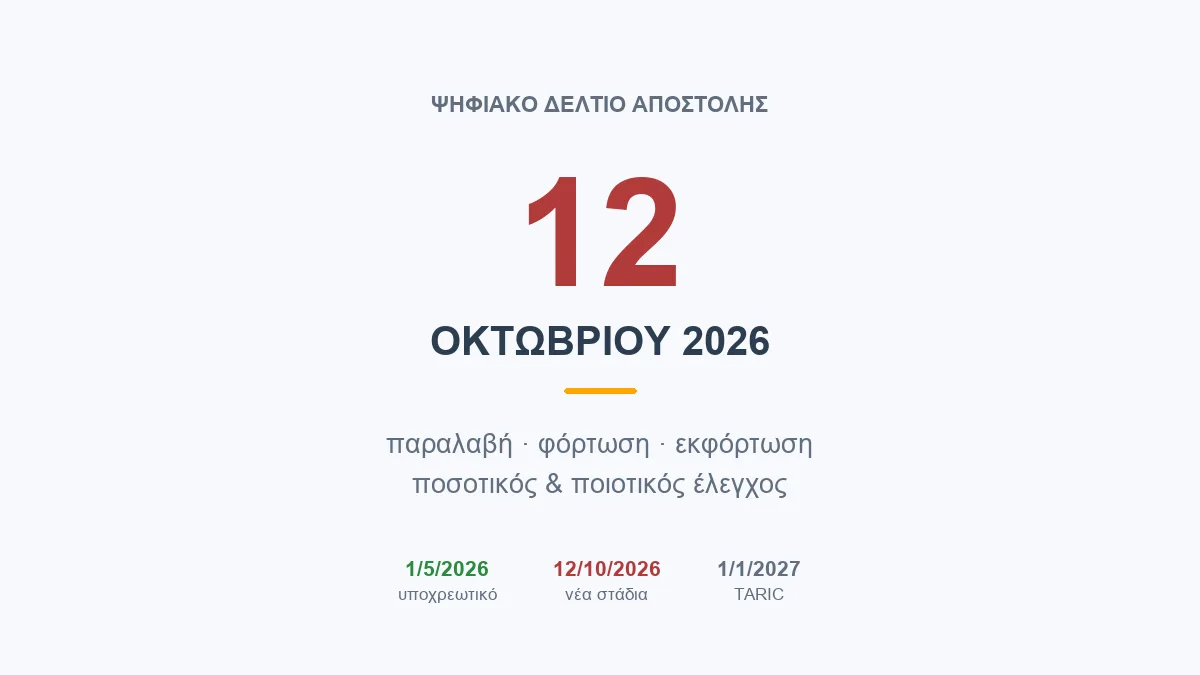
- Until 30 April 2026 — Phase B data transmission was optional.
- From 1 May 2026 — it became mandatory. If you move goods, you are already covered by it.
- 12 October 2026 — the procedures for receipt, loading and unloading, and the transmission of quantity and quality inspection data, take effect. The Consolidated Dispatch Note could be issued by hand until 11 October 2026; from the 12th, it must be digital.
- 1 January 2027 — uniform item coding under the Combined Nomenclature (TARIC).
12 October is not “just another date”. Until now, the focus was on issuing the document. From now on, the system wants to know what happened to the goods: who received them, when they were loaded, when they were unloaded, and what the inspection found.
What changes for the software in practice
Until now, many businesses dealt with dispatch notes the simple way: issue, transmit, done. One point, one call.
From 12 October, that is no longer enough, because the movement of goods gains a lifecycle. The same document is updated at several stages, by different people, at different times, and often on different devices. The warehouse worker loading the goods is not sitting at the same machine as the accountant.
If your software treats the note as “a document that has been issued” rather than “a process that is unfolding”, that is where it will break.
What to ask the person building your software
You do not need technical knowledge. You need to ask the right questions before the 12th:
- “Do we already support the receipt and loading stages, or only issuing the document?” If the answer is “only issuing”, there is work to do.
- “What happens if myDATA goes down during loading?” There needs to be a queue and retries, rather than a lost submission. The lorry will not wait for the API.
- “Who presses the button in the warehouse?” If the process requires someone to log into the ERP at a desk, it will not happen. It needs something that works on a phone.
- “Do we keep what we sent and what AADE replied?” Without a record of responses, you have nothing to show during an inspection.
- “What are we doing about TARIC?” That is for January, but read on to see why it cannot wait.
TARIC is not a January problem
From 1 January 2027, items need uniform coding under the Combined Nomenclature.
It sounds like something you can sort out in December. It is not. It is data work, not coding work: someone has to sit down and match each item code to the correct tariff code. With five hundred items, that takes a week. With five thousand, it takes a month, and the programmer is not the person doing it: it needs someone who knows what you sell.
December is the worst month to discover this.
What I see breaking most often
From what I have seen in systems connected to myDATA, three problems keep recurring:
1. Transmission happens synchronously. The user clicks “issue” and waits for AADE to reply. When myDATA is slow, the screen freezes and people click again, creating duplicates. Transmission needs a queue.
2. There is no audit trail. You send something, get a response, and discard it. A dispute then arises, and you do not know what was sent or when.
3. Errors never reach a person. Transmission fails, the error goes into a log nobody reads, and you find out from the accountant three months later.
What you can do in twelve days
There is not enough time to rewrite a system. But there is time to:
- Ask your provider today, rather than on the 11th. If an upgrade is needed, it takes planning.
- Test one real movement of goods from end to end before the deadline, rather than on the first day with a real customer.
- Start on TARIC. It is the one part nobody can do for you at the last minute.
An honest note
I am not your accountant, and this is not tax advice. I am writing about the part I know: what the software needs to do. For what applies to your own business, including exemptions, turnover and sector, ask your accountant.
The dates mentioned come from published sources and were valid when this article was written. myDATA deadlines have been extended several times. Verify them before relying on anything here.